Nimrod
As Galadriel reminds us at the beginning of Peter Jackson’s film of Tolkien’s The Fellowship of the Ring: With the passage of time, history becomes legend and legend becomes myth. This is certainly true in the case of Nimrod.
As a flesh and blood personality, Nimrod is mentioned in Genesis. He is the great grandson of Noah. and he is the King of Shinar who ‘became mighty in the world’. The Book of Genesis also names cities of cultural significance which Nimrod founded in southern Mesopotamia, including Babylon where the Tower of Babel drama was to take place. However, details about Nimrod’s involvement in the building of this symbol of defiance are to be found, not in The Bible but in surviving Bronze Age records, and later, in the works of Flavius Josephus, the First Century AD Governor and Historian of Judea.
Later still, Nimrod’s life and doings became part of Islamic narrative. Memorials to Nimrod are to be found in different parts the world and characters based upon the Nimrod archetype appear under different names in the literature of many cultures, including one as far removed from Middle Eastern as Finnish.
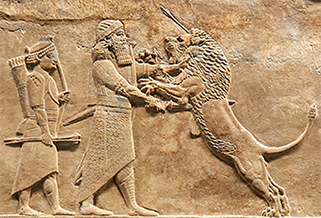
He is always presented as a great warrior, able to protect the integrity of his lands against invaders, and a rebel against God, who exhorts his subjects and those who follow him to take credit for their own actions and successes, rather than disempowering themselves by attributing them to God.
Down the ages, researchers of different nationalities, representing branches of academic study have tried – inconclusively – to identify certain historical personalities with Nimrod, but Nimrod belongs to humanity, not to a specific time or place. The Nimrod archetype reveals the aspect of man which resents being under the control of an authority higher than himself, especially when he perceives that he has been ‘failed’ by that authority, notably a God who returns devotion with floods, famine, and warfare. Nimrod had his great grandfather’s experience to draw upon, experiences that would impress themselves indelibly on the collective unconscious. The Tower of Babel was built to withstand further devastating floods.
In the modern world, Nimrod is most insistently present whenever those born with Pluto in an Air sign are in the ascendancy, i.e., in mature adulthood and at the height of their influence in their societies. This was the case at the end of the 18 century / beginning of 19th century (Pluto in Aquarius) when Napolean was following his example and restructuring Europe under his Code. (Pluto was in Gemini 1883 – 1914; and in Libra 1971 -1984). Now, Pluto is back in Aquarius once more, and, this summer, is retrograding the exact degree it occupied when Napoleon was born.
Owing to Pluto’s elliptical orbit, it spends differing amounts of time in different signs. The relatively short time Pluto spends in Libra, Scorpio and Sagittarius means that when Pluto goes into Aquarius, a generation with Pluto in an Air sign is being born at the same time as those with Pluto in an Air sign are in Ascendancy.
So Nimrod will be stalking this earth again for the next quarter of a century. Maybe he has an important job to do in his way and in his time. This runs out in 2043 when Pluto enters Pisces.
There is no place for a transcendent God in Nimrod’s world. If there is nothing higher than us to sort out the mess we have made of our world, it could be encouragement for us to create a new relationship with responsibility, for ourselves, for humanity, for nature and for our planet. However, this opportunity comes at a price because in these circumstances, when the focus is insistently rational and intellectual, we do not develop emotional being, and in everyday life, love and compassion are ever more thinly spread like butter scraped from its wrapper. Our world becomes a multiplicity of worlds which get smaller, tighter, more competitive, more materialistic and more obsessed with detail. Each of us becomes a detail requiring more attention and recognition. The spiritual templates which train us to challenge ourselves fall into disuse and there is nothing but other egotistic individuals to challenge our own self-importance.
But if this is the time we have confronting us, we must use it as well as we can to meet the challenge of climate change with powerful and creative intellects and the systems they are developing. We must make them purposeful.
Wikipedia has a very informative entry on Nimrod which has greatly enhanced my own knowledge of him and includes a photograph of Yitzhak Danziger’s famous statue of Nimrod which is housed in the Isreal Museum, and which c captures attitude better than any statue I have ever viewed.
Danziger grew up in the ascendancy of the generation with Pluto in Gemini. As a generation, they were disposed to reject God even before the debacle of WW1. They wrote many books and much of what they wrote was concerned with a wholesale rejection of values which had shaped their parents and their lives. They were concerned with expressing individuality and taking control of their own lives. Physical and sexual well-being were considered important aspects of this.
Danziger, a Jew, was born in Berlin. As a young teenager, some years after his family had relocated to Tel Aviv, he spent a short time back in Berlin when young Germans were particularly concerned with physical fitness and exercise. Not long after that experience, he studied in England with the young people who were reading books and poems written by the writers with Pluto in Gemini. This awareness of human entitlement surely went into his statue. Sculptured between 1938-9, his Nimrod, glancing up at Heaven in defiant rejection, is young and beautiful, but his arrogant face is hard and grim, sad even.
Danziger had watched the rise of Nazism and saw Europe preparing for another world war. So individual autonomy and supermen were not the answer after all.
There is no answer to the human condition. It is the compost in which individuals grow into creative individuals who can fulfill the role allotted to the human kingdom in our Solar system. To do this, we must find ways of releasing ourselves from the compost. This has been the message of spirituality from the beginning and is implanted for all time in the knowledge contained in the major religions of the world.
In different eras we focus upon different methods, and make different relationships with religion itself, but the truth remains the same and they all direct us to find the means of release within ourselves.
In this Aquarian era, with a transcendent God no longer in view, the group may acquire a role which enables it to serve as an intermediary and challenge the egotism, materialism and lack of vision which keeps us swimming round in our chilly, empty goldfish bowls, staring at screens and images rather than actualities, and taking selfies.
Let us hope so, because the biggest enemy of conscious evolution is the absence of a sense of purpose that makes us seek refuge in the kind of materialism that itself has no purpose.